

The Price of Disconnection in Tokenized Assets
The promise of tokenized real-world assets (RWAs) is immense: bringing trillions of dollars of traditional assets onto the blockchain, fostering increased liquidity, and opening up new investment opportunities. However, a significant hurdle threatens to undermine this potential. A recent report from RWA.io highlights the detrimental effects of blockchain fragmentation, estimating that inefficiencies are costing the market up to $1.3 billion annually. This fragmentation, the report argues, is not just a technical inconvenience, but a substantial economic drag on the entire sector.
Silos and Slippage: The Root of the Problem
The core issue lies in the proliferation of independent blockchain networks. While each chain offers unique features and advantages, the resulting silos restrict the free flow of capital and information. This creates persistent price discrepancies for identical assets trading on different chains. Imagine owning a tokenized share of a company that trades at slightly different prices on Ethereum versus Polygon. In traditional finance, arbitrageurs would swiftly capitalize on these differences, buying low on one exchange and selling high on another. However, the complexities and costs of moving assets across blockchains — involving fees, slippage, and operational risks — often make this arbitrage unviable.
The High Cost of Moving Capital
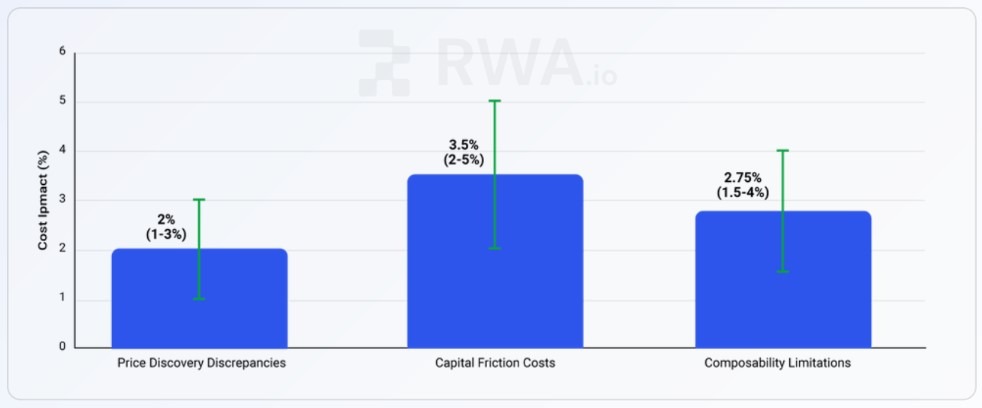
The report underscores that moving capital between non-interoperable chains can incur losses of 2% to 5% per transaction, stemming from a combination of factors. These include exchange fees, slippage (the difference between the expected and actual price of a trade), transfer costs, gas fees (the cost of executing transactions on a blockchain), and timing risks. Aggregated, these frictions translate to an average loss of roughly 3.5% per capital reallocation. This is a significant impediment to market efficiency, preventing the kind of seamless and frictionless transactions that are expected in a well-functioning financial system.
Scaling the Problem: Potential Losses in a Multi-Trillion Dollar Market
The implications of these inefficiencies are particularly concerning when considering the projected growth of the RWA market. RWA.io forecasts that the tokenized asset market could swell to $16 trillion to $30 trillion by 2030. If the existing fragmentation persists, the associated friction could result in annual losses of $30 billion to $75 billion. This highlights the urgent need for solutions that address interoperability and bridge the gaps between various blockchain ecosystems.
Towards a More Interconnected Future
The challenges identified by RWA.io are not insurmountable. The industry is actively working on solutions like cross-chain bridges, decentralized exchanges (DEXs) that facilitate trades across multiple chains, and advancements in layer-2 scaling solutions that aim to improve transaction speeds and reduce costs. The success of these initiatives is crucial for unlocking the full potential of tokenized assets and fostering a truly integrated and efficient financial ecosystem. As Marko Vidrih, co-founder and chief operating officer at RWA.io, stated, “Tokenized assets should be just as frictionless” as traditional financial transactions, such as the EU-wide SEPA Instant payments. Achieving this frictionless environment is key to propelling the next wave of crypto adoption.
The industry is optimistic that these advancements will pave the way for a more integrated and efficient financial future.

