


Italy’s Central Bank Examines Ethereum‘s Resilience
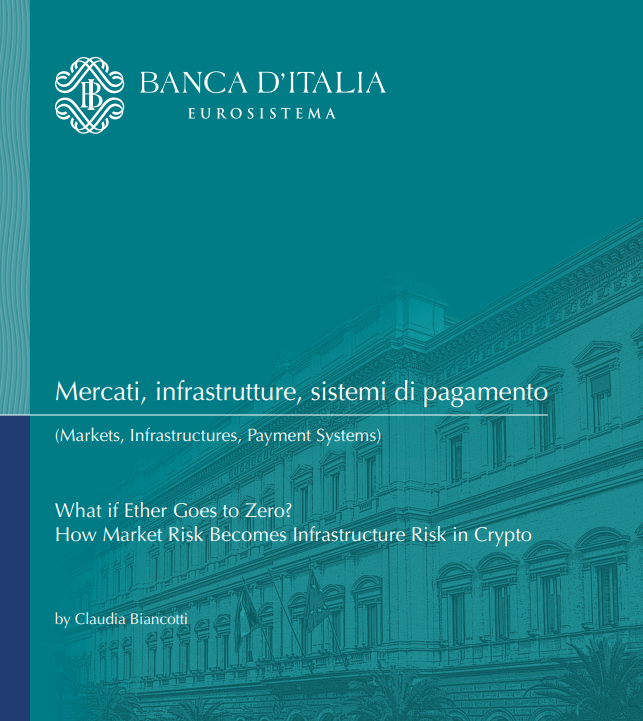
The Bank of Italy recently released a research paper exploring a highly improbable, yet crucial, scenario: what if Ether (ETH) plummeted to zero value? The study, titled “What if Ether Goes to Zero? How Market Risk Becomes Infrastructure Risk in Crypto,” delves deep into the potential ramifications of such an event, offering a stark assessment of Ethereum‘s vulnerabilities and its growing importance within the financial landscape.

From Speculation to Infrastructure: A Paradigm Shift
The Bank of Italy‘s analysis departs from the common perspective of treating Ether solely as a volatile asset. Instead, it views ETH as a fundamental component of Ethereum‘s infrastructure, especially regarding settlement and transaction processing. This shift in perspective allows the study to model how extreme market shocks can translate into operational and infrastructural risks for various on-chain applications, including stablecoins and tokenized assets.
Validator Incentives and Network Stability
A key focus of the research is the behavior of validators, the entities responsible for securing the Ethereum network. Since validators are rewarded in ETH, a drastic decline in its value could significantly impact their economic incentives. The paper posits that a significant price drop could lead some validators to exit the network, reducing the total stake securing Ethereum. This, in turn, could slow block production, weaken the network’s defenses against attacks, and compromise its ability to guarantee the final settlement of transactions.
Ripple Effects: Beyond Crypto Trading
The Bank of Italy‘s assessment isn’t limited to the impact on speculative trading. The research emphasizes that disruptions could extend to payment and settlement use cases, which are increasingly under regulatory scrutiny. This highlights the potential for broader systemic effects, affecting regulated financial activities that rely on Ethereum infrastructure.
Regulatory Dilemma: Balancing Innovation and Stability
The paper concludes by highlighting a difficult trade-off faced by regulators. The Bank of Italy suggests two potential approaches:
- Treating public blockchains like Ethereum as unsuitable for regulated financial infrastructure due to the volatility of their native tokens.
- Allowing the use of public blockchains while imposing risk mitigation measures, such as business continuity plans, contingency chains, and stringent standards for economic security and validators.
The study underscores the critical need for regulators to understand and address the risks associated with the increasing integration of public blockchains into the financial ecosystem. As Ethereum continues to evolve and attract wider adoption, the insights from this research will become increasingly important for ensuring financial stability.
Broader Context and Global Concerns
The Bank of Italy‘s findings echo concerns raised by other global financial authorities, including the International Monetary Fund (IMF) and the European Central Bank (ECB), regarding the potential risks associated with stablecoins and their increasing connections to traditional finance. These authorities recognize the need for proactive regulation and risk management to mitigate potential systemic threats within the rapidly evolving crypto landscape.

