The Dark Side of Crypto PR: A Flood of Red Flags
A recent industry report has shed light on a concerning trend within the cryptocurrency space: the dominance of high-risk projects and scams in the world of press releases. According to analysis conducted by crypto communications company Chainstory, a significant majority of press releases published between June and November 2025 originated from projects flagged as “high risk” or outright scams. This raises serious questions about the integrity of information disseminated to the public and the potential for market manipulation.

The Numbers Don’t Lie: High-Risk Projects Lead the Pack
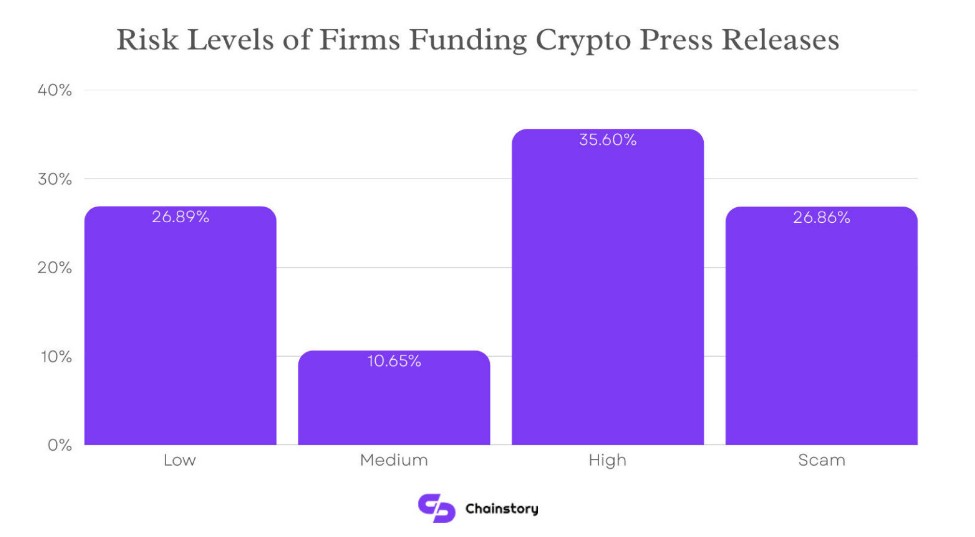
The report analyzed a dataset of nearly 3,000 press releases, meticulously categorizing issuers based on their associated risk levels. The findings were alarming. A staggering 62.5% of the releases were linked to high-risk activities, including projects promising unrealistic yields and those with copy-pasted websites. Furthermore, projects classified as “high risk” accounted for a substantial 35.6% of the total releases, while known scams contributed an additional 26.9%. In contrast, low-risk projects, often characterized by doxxed teams and no unresolved security issues, accounted for only 27% of the released announcements. This disparity underscores a troubling reality: the most visible projects are often the ones with the most to hide.
The Strategic Advantage of Shady Projects
Legitimate projects, according to Chainstory, tend to rely less on the mass distribution of press releases. They often attract organic media coverage or opt for more targeted communication strategies. High-risk projects, on the other hand, frequently employ a “shotgun” approach, flooding the market with their announcements across multiple distribution channels. This strategy, while potentially increasing visibility, can also be a red flag. Search engines often suppress duplicate content, meaning that many of these releases are filtered out, leaving only a few indexed versions visible. This creates a situation where the loudest voices, not necessarily the most trustworthy, dominate the conversation.
Press Releases as a Weapon: Manipulating Markets
The report highlights the potential for market manipulation through the abuse of press releases. Historically, these releases have been a common tool in traditional finance (TradFi) for misleading investors, and this pattern is mirrored in the crypto world. Cheap distribution and weak scrutiny make it easy for risky projects to push their own narratives. The U.S. Securities and Exchange Commission (SEC) has recognized this, pointing to the link between promotional campaigns and market manipulation.
“We’ve seen tokens that barely have any real user base jump in price after a series of press releases announcing partnerships or future plans (which often never materialize beyond the press release),” Chainstory reported.
Real-World Examples of Deception
The report cited several examples of how press releases have been used to mislead investors. In one instance, a fake press release claiming Walmart would accept Litecoin caused a significant price spike before being debunked. More recently, a fraudulent platform masquerading as USDC’s issuer, Circle, used a deceptive press release to attract unsuspecting users. These examples highlight the ease with which bad actors can create false narratives and the potential for significant financial damage.
The Future of Crypto Communication
The dominance of high-risk projects in the press release landscape poses a challenge to the integrity of crypto news and market stability. As the industry matures, stricter scrutiny and more transparent communication practices are essential. The problem isn’t the press release format itself, but the ease with which it can be exploited by those seeking to deceive. Readers should approach information with a critical eye, verifying claims and always conducting thorough research before making any investment decisions. This report serves as a stark reminder of the importance of vigilance and the need for greater transparency within the crypto ecosystem.