

African Stablecoin Conversion: A Pricey Proposition
Recent data paints a complex picture of stablecoin adoption in Africa, highlighting significant conversion cost disparities across the continent. Analysis by payments infrastructure company Borderless.xyz, focusing on 66 currency corridors, reveals that stablecoin-to-fiat conversion spreads in Africa are notably higher than in other regions, challenging the perception of stablecoins as a consistently cheaper alternative to traditional remittance services.

Wide-Ranging Spreads Across the Continent
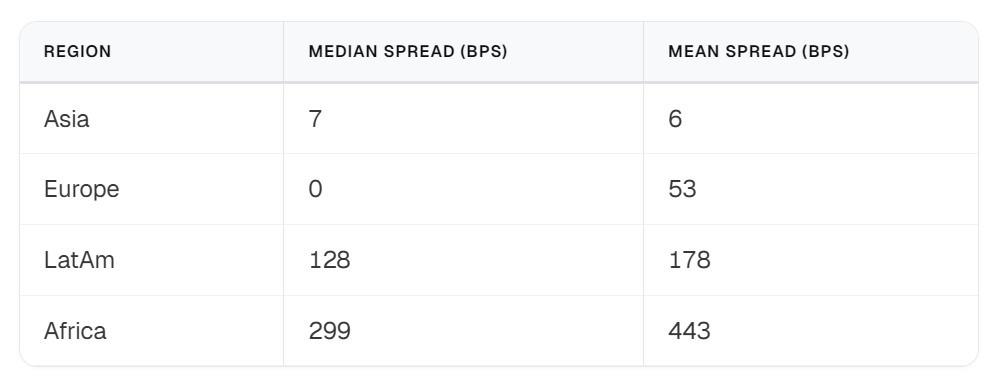
The median spread for stablecoin conversions in Africa reached approximately 3% in January, translating to 299 basis points. This figure contrasts sharply with the roughly 1.3% observed in Latin America and a mere 0.07% in Asia. Furthermore, the data unveils a substantial range within Africa itself. Conversion costs varied from a relatively low 1.5% in South Africa to a staggering 19.5% in Botswana. These “spreads,” essentially the gap between a provider’s buy and sell rates, represent the execution cost of converting stablecoins into local currencies.
Competition as a Key Driver
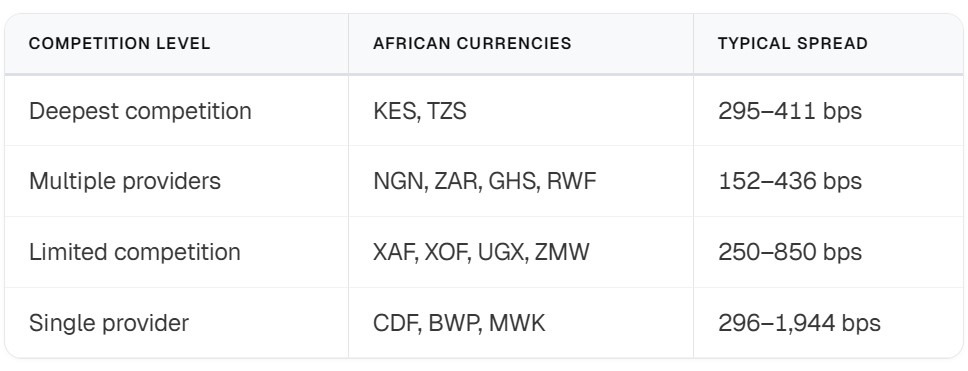
The report underscores the critical role of competition in determining these conversion costs. Markets with multiple providers generally exhibited significantly lower costs, ranging between 1.5% and 4%. Conversely, areas dominated by a single provider frequently saw costs exceeding 13%. This suggests that the competitive landscape, alongside factors like liquidity, exerts a more powerful influence than the underlying blockchain technology. Botswana’s high costs, for instance, highlight the potential impact of limited provider options.
Stablecoins vs. Traditional FX: The Premium Debate
The analysis also compared stablecoin exchange rates with traditional interbank foreign exchange (FX) rates, introducing a metric known as the “TradFi premium.” Globally, the difference between stablecoin exchange rates and traditional mid-market FX rates was minimal, averaging around 0.05%. However, in Africa, this gap widened to about 1.2%, though this varied considerably by country. While stablecoins offer faster settlement times and potential cost savings, the data suggests that these benefits can be significantly offset by high conversion costs in certain corridors.
Economists and industry experts often highlight stablecoins‘ potential to reduce remittance costs in Africa, where traditional services can be expensive. However, this new data suggests a nuanced reality. While stablecoins offer a compelling alternative, especially in terms of speed, the high conversion costs in certain markets hinder their widespread adoption. Increased competition, improved liquidity, and more transparent pricing models are crucial for unlocking the full potential of stablecoins to revolutionize financial services across Africa.

