Ethereum: The Blockchain‘s Operating System
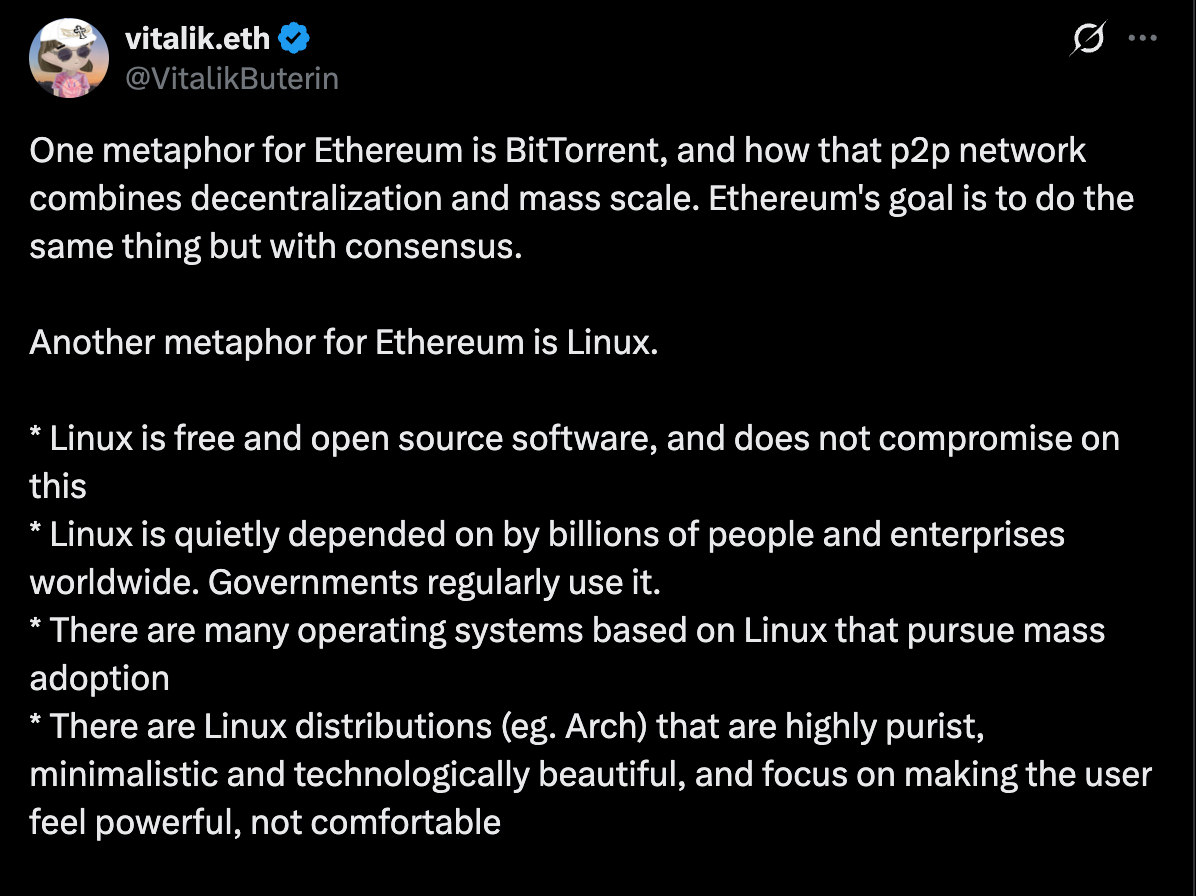
In a recent statement, Ethereum co-founder Vitalik Buterin drew a compelling parallel between his creation and the venerable open-source operating system, Linux. This comparison serves as a potent reminder of Ethereum‘s foundational aspirations: to become the infrastructural backbone for a decentralized web, handling not just data, but also value, identity, and governance.

Similarities and Aspirations
The core of the analogy rests on the shared principles of open-source development and community-driven innovation. Both Linux and Ethereum empower users with autonomy and resist centralized control. Linux has powered the digital world for decades, running on everything from supercomputers to smartphones. Similarly, Ethereum aims to provide an environment for individuals and organizations seeking self-sovereignty in the digital realm, free from the constraints of intermediaries.
Buterin’s observation also implicitly acknowledges the significance of Ethereum‘s scaling solutions, particularly Layer-2 (L2) networks. While Linux gains functionality through developers customizing software, Ethereum scales through L2s. These networks, built atop the Ethereum base layer, aim to improve transaction throughput and reduce costs. The vibrant ecosystem of L2s allows for experimentation with different execution environments and block times, driving innovation within the Ethereum ecosystem. However, it also presents challenges.
Challenges of Fragmentation
The proliferation of L2 networks raises concerns about fragmentation. With numerous chains emerging, ensuring interoperability and preventing the isolation of user liquidity becomes critical. Without robust interoperability, users might find their assets locked within isolated pools, diminishing the overall user experience. This underscores the need for effective bridge technologies and standardization efforts.
The Ethereum Foundation’s vision, as outlined by Buterin, is ambitious. It envisions Ethereum as the home for individuals and organizations seeking enhanced autonomy and access to the full power of the network. This journey demands continuous improvement, with a focus on both scalability and interoperability. The success of Ethereum will depend on its ability to evolve, adapt, and ultimately, become the robust and versatile operating system for the decentralized future.
The future of Ethereum hinges on several key factors. These include the success of its Layer-2 scaling solutions, the fostering of a vibrant and collaborative developer community, and the ongoing commitment to decentralization. If Ethereum can navigate these complexities, it stands to establish itself as the bedrock of a truly decentralized internet, much like Linux has in the existing digital landscape.