


Buterin’s Blueprint for Better DAOs
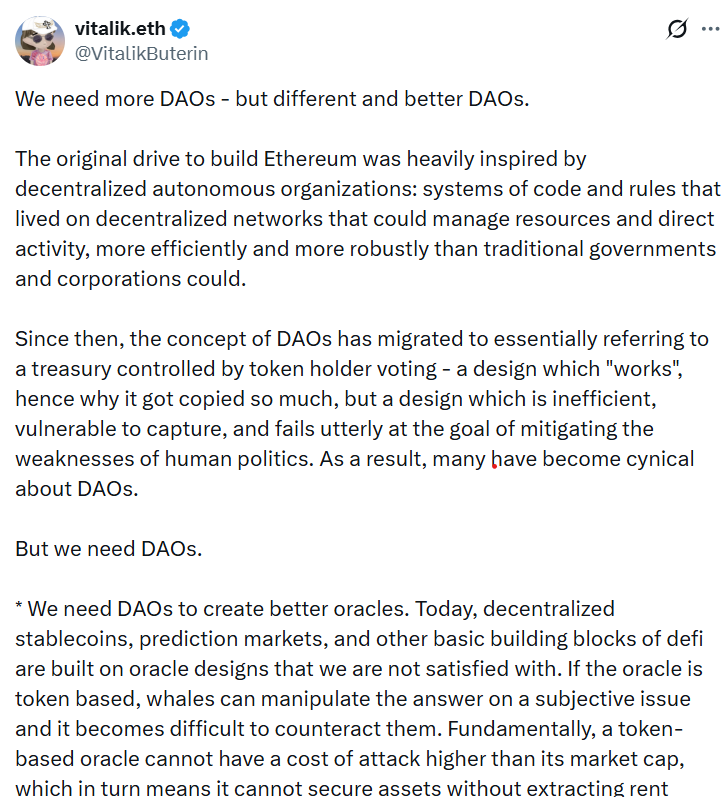
Ethereum co-founder Vitalik Buterin has once again sparked debate within the crypto community, this time with a call for a significant overhaul of Decentralized Autonomous Organization (DAO) design. In a recent post, Buterin argues that the current model, often centered around simple token-voting treasuries, is insufficient to overcome the challenges of governance and is vulnerable to capture.

From Treasuries to Core Infrastructure
Buterin envisions DAOs moving beyond their current limitations to power crucial infrastructure. This includes robust systems for on-chain dispute resolution, improved oracle functionality, and long-term project stewardship. He believes that by addressing these core functions, DAOs can become significantly more effective than traditional corporate and political structures. He suggests that DAOs should be crafted to tackle specific infrastructure problems rather than merely managing funds.
Navigating the Convex vs. Concave Divide
Buterin re-emphasizes his “convex vs. concave” governance lens. For “concave” problems, where compromise is key, DAOs should prioritize robustness and aggregate input from various sources. For “convex” problems, where decisive action is needed, he advocates for strong leadership, coupled with accountability mechanisms to ensure responsible decision-making, rather than a purely decentralized approach. This nuanced approach demonstrates a realistic understanding of the diverse challenges faced by DAOs.
Addressing Privacy and Decision Fatigue
Critical to the success of this new DAO paradigm, according to Buterin, are solutions for privacy concerns and decision fatigue. Without privacy, governance can devolve into a “social game”, and constant voting can lead to engagement drop-off. He suggests zero-knowledge proofs, secure multi-party computation, and fully homomorphic encryption as potential privacy solutions. Furthermore, he explores the use of artificial intelligence to support analysis and allow users to delegate voting, while cautioning against AI-run DAOs.
The Path Forward for DAOs
Buterin’s proposals are timely, considering the current landscape of the DAO ecosystem. While DAO tokens currently boast a market capitalization of billions of dollars, challenges persist in terms of participation and potential whale capture. Buterin emphasizes that projects building new oracles and governance systems should dedicate a significant portion of their efforts to DAO design and the associated communication layer, not just focus on technical components.
“If you want Ethereum’s decentralized base layer to carry through to the apps built on top, DAO design needs 50% of the attention, not 10%,” – Vitalik Buterin
Ultimately, Buterin’s vision for the future of DAOs underscores the need for innovation and a willingness to adapt. By focusing on core infrastructure, addressing critical issues like privacy, and acknowledging the complexities of different governance models, DAOs can move towards realizing their full potential as powerful and effective tools for decentralization.

